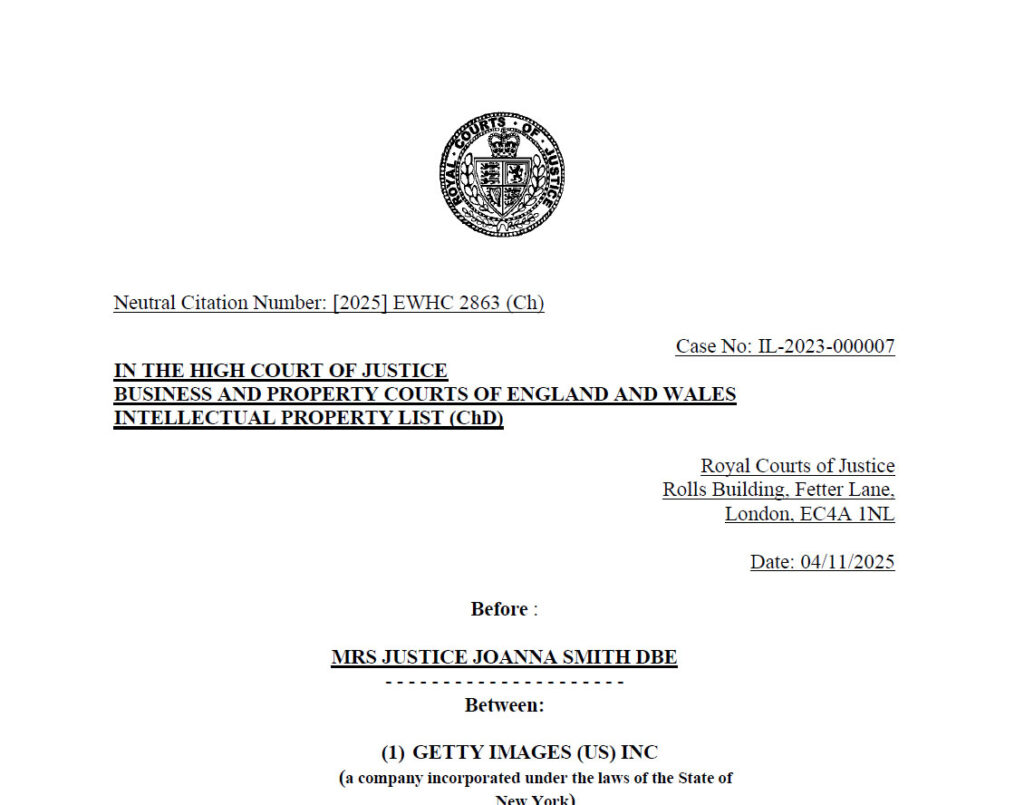
We have followed and commented on the case of Getty Images v Stability AI since the claim was issued and also compared it to other European approaches. The litigation raises issues at the intersection of copyright, trademarks and generative AI that are already shaping how clients approach dataset curation, licensing and the deployment of models. The UK High Court has now granted an appeal in this case, concerning the secondary coypright infringement case.
This update summarizes the High Court findings at first instance and explains the narrow point of law on which the Claimants have obtained permission to appeal.
Executive Summary
- At trial the High Court found against Getty Images on its secondary copyright infringement claim.
- The court did uphold limited findings of trademark infringement.
- The High Court judge has now granted permission to appeal only in relation to the secondary copyright infringement claim on the narrow, legal point of statutory construction about what constitutes an “infringing copy” or “article” under the Copyright, Designs and Patents Act (CDPA). Permission to appeal the trademark findings was refused.
Brief Case Background
The Claimants, Getty Images and related companies, alleged broadly that Stability’s training of its Stable Diffusion AI models involved scraping and using large numbers of Getty images and that the resulting models and outputs gave rise to multiple causes of action, such as primary copyright infringement in outputs, database rights claims, trademark infringements and secondary copyright infringements under s.27 CDPA, alleging that the AI model itself constitutes an article or an infringing copy and thus being practical purposes an infringing copy. The Claimants subsequently narrowed their case during the litigation, abandoning some aspects, but continued to press the trademark and the secondary infringement claims.
Two important features:
- Stable Diffusion architecture versus “copies”. AI models use learned parameters (weights) derived from training data. The parties disputed whether those parameters or the trained model can be treated as an infringing copy or an article capable of being imported, distributed or otherwise the subject of secondary infringement under UK statute.
- Watermarks in synthetic AI outputs. A number of factual and contextual questions arose about whether certain synthetic images produced would present an average consumer with a sign capable of infringing Getty’s trademarks.
What the High Court decided
(A) Trademark and passing off claims.
Mrs. Justice Joanna Smith conducted a detailed factual and legal analysis of the trademark issues. The judge concluded that, in specific circumstances (for specified AI model versions and access routes), certain synthetic images generated by users could amount to trade-mark infringement under the Trade Marks Act 1994, although the findings were carefully drawn and limited in scope. The decision stresses that some aspects of the trademark claim were historic or confined to particular access mechanisms and model versions.
In short: Getty achieved a partial victory on trademarks, but the findings were narrow and depend on the model/version/access combinations that were the subject of trial evidence.
(B) Secondary copyright infringement.
The High Court summarized the issues and the statutory framework applying to secondary infringement (sections 22, 23 and, centrally, section 27(3) CDPA). Although the judge engaged with the key legal arguments (including those that turn on the meaning of “article” and “infringing copy”), she did not fully decide one of the main questions of statutory construction at that stage, observing that fuller argument and factual findings were necessary. Ultimately, however, the secondary infringement claim was dismissed on the evidence before the court. The judgment expressly records both the legal complexities and the novel nature of the issues raised.
High Court Permission to Appeal
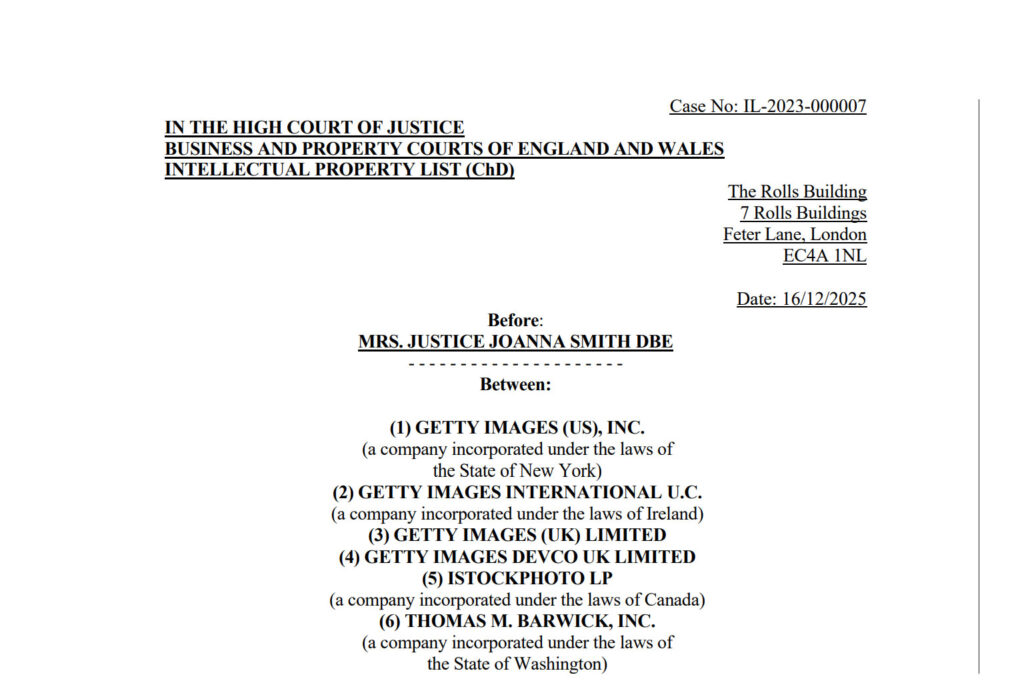
Following delivery of the judgment, the Claimants applied for permission to appeal the dismissal of the secondary infringement claim. In an order dated 16 December 2025 the High Court judge granted permission to appeal in relation to that issue. The reasons are as follows:
- The issue is a question of law, not fact. It principally concerns statutory construction of the CDPA (not disputed primary facts).
- The point is novel. The phrase “infringing copy” and the related statutory language around the meaning of “articles” has not previously been authoritatively construed in the context of machine learned models and intangible articles, such as software or model weights. The judge considered that “reasonable lawyers may well differ on the proper construction” and that the question has potentially far reaching ramifications for AI models and for software or intangible articles more generally.
Conversely, the judge has refused permission to appeal in relation to the defendant’s attempts to challenge the trademark findings. The stated grounds were judged to be primarily fact based and without a real prospect of success on appeal.
Practical takeaways
- If you build or licence training datasets, re-examine licence terms and vendor representations. The permitted or forbidden uses and territorial scope of licences are central to the kinds of entitlement arguments that the High Court said will feed into the secondary infringement debate.
- When deploying models commercially, ensure model governance records clearly trace the provenance of training data, access mechanisms and the chain of distribution. Even if a model itself ultimately is not an “infringing copy”, the evidential record about how models were trained and distributed will also be critical in future disputes.
What to Watch Next
- The UK Court of Appeal timetable and papers. The permission order is the gateway and the Court of Appeal will decide whether to hear the full appeal on the point of statutory construction and then determine the question on the merits. The eventual appellate decision will be the critical authority for parties and practitioners.
- How other jurisdictions respond. Although this article is focused on the UK litigation, note should be taken of related cases and regulatory developments in other jurisdictions, because cross referencing is likely to follow a major appellate ruling in a case of this profile.